virtualDavis

\ˈvər-chə-wəlˈdā-vəs\ Blogger, storyteller, flâneur. G.G. Davis, Jr's alter ego…
Twitter
@virtualDavis
Facebook
virtualDavis

Marginalia: Billy Collins

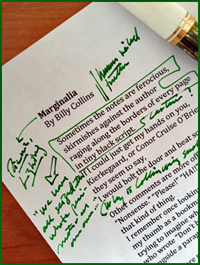
Marginalia, by Billy Collins

Marginalia, by Billy Collins

Last week I shared one of my favorite Billy Collins poems, ”Marginalia”, with my reading group. I was surprised how few had heard/read it before. Billy Collins has enjoyed the poet equivalent of rock star status over the last decade, and yet nobody seemed familiar with Collins’ meandering reflection on one of my favorite subjects.

While the poem’s charm and much of its aural appeal resides in the specific instances of marginalia which Collins includes (calling out Kierkegaard, dissing Dickinson, bravo-ing Baldwin, etc.), there are three excerpts that contribute handily to the universal notion of marginalia, and I’d like to pass them along.

Sometimes the notes are ferocious,
skirmishes against the author
raging along the borders of every page
in tiny black script.

[…]

Students are more modest
needing to leave only their splayed footprints
along the shore of the page.

[…]

We have all seized the white perimeter as our own
and reached for a pen if only to show
we did not just laze in an armchair turning pages;
we pressed a thought into the wayside,
planted an impression along the verge.

~ Billy Collins, ”Marginalia” (Poetry Magazine, February 1996)

Spot on! One, two, three perfectly captured truths about marginalia.

Collins is a member of your family, your best friend, sharing everyday moments and feelings so vividly they become your memories as well. (Jason Weisberger, Boing Boing.)

I’m still slightly perplexed by the almost combative bent of the marginalia scribblers early in the poem. While there’s a steady evolution toward less antagonistic marginalia penned by students and admirers, a shift accentuated by the love stained finale, I don’t completely grok the poet’s intentions. Perhaps hostile marginalia is sufficiently foreign to me that I lack the requisite context. I’ll work on that!

But the notion of challenging the author on his/her own playing field (or just off the edge of the playing field) is familiar. As is the curious human instinct to plant a personal flag. I was here. I staked this ground. I exist… For me this latter category often falls under the category of reminders. Can I find this passage or that reference easily later? Let’s make sure.

Marginalia was first published in Picnic, Lightning and later included in the collection Sailing Alone Around the Room: New and Selected Poems. If you’d like to read the whole poem now, you can access it online as reproduced from the February 1996 issue of Poetry Magazine. As with most of Billy Collins’ poems, this deserves to be read aloud. Once you’ve heard the poet read aloud, you’ll forever hear his voice when you read his words. But even in your own voice, you’ll bring the words to life in a way that they deserve. Enjoy!

Victor Kossakovsky’s Lullaby

Dare to start your day with a lullaby? Good luck!

Victor Kossakovsky’s poignant three minute documentary about homelessness strips away all but the most most critical narrative elements: several simple shots of vagrants sleeping in a bank’s ATM foyer, three brief scenarios with ATM clients, ambient urban street noise, and an evocative “lullaby” which simultaneously soothes and mocks. The result is subtle, disturbing and captivating. I’ve already watched Lullaby twice this morning. I’ll watch it again.

Victor Kossakovsky

Victor Kossakovsky (Photo: Bert Kommerij)

The film poem’s location (Berlin) and music (sung by Nadezhda Utkina, an ethnic Udmurt) are foreign, but the theme is universal. Unlike the preachy, precious and shock mongering poverty diatribes with which we’re familiar,  Kossakovsky’s Lullaby offers a more complex snapshot of the problem.

I biked around my neighborhood and started filming. In one of my favorite moments, a woman opened a door leading to the A.T.M.’s and, when she realized that there were people sleeping inside, slowly closed the door and tiptoed away, saying, “Sleep well!” ~ Victor Kossakovsky (NYTimes.com)

Seen through the eye of the camera we don’t initially know why the woman stalls. I imagined her deliberating, calculating the risks of entering. Is she in danger? Will she be mugged? And then she turns slowly, quietly and leaves without using the ATM out of deference to the sleeping homeless people.

Victor Kossakovsky’s nuanced approach, enhanced by coupling a gritty urban scenario with a tender and innocent lullaby, leaves the viewer with more questions than answers. No tidy takeaway here. The mark of a gifted storyteller.

Victor Kossakovsky Update:

Returning to the NYTimes.com post I was surprised to discover no comments about Lullaby. I’ve primed the pump with the hope that it will prompt deserved praise for Victor Kossakovsky and perhaps prompt some debate among viewers less smitten. My comments won’t appear until moderated, so here’s what I wrote:

Subtle, poignant and haunting. I’ve watched the video twice driven by the same instinct that often compels me to read a poem twice, to perpetuate the experience and to swim deeper into its message. Victor Kossakovsky’s “Lullaby” offers a fresh (and overdue) look at the complexity of homelessness without preaching or reducing his message to a precious Helvetica slogan. Bravo!

Perhaps you’d like to share your reaction with Kossakovsky too? Let’s jumpstart the discourse!

Bag of Dust or Self-Help Book?

Sarah Salway's poetry collection, You Do Not Need Another Self-Help BookI started my morning with Dust, a poem by Sarah Salway (@sarahsalway).

More accurately, I started my morning with Sarah Salway. She read her dusty poem. Aloud.

You might consider starting your morning the same way. If it’s not already too late. Or even if it is…

I’ve listened to the poem — from her newest poetry collection, You Do Not Need Another Self-Help Book — three times so far. In fact, I’m afraid I may have inhaled some of the dust while listening. The idea of hording and absorbing a bag of dust, all that remains of a departed spouse, won’t abandon me. Salway’s lines stride — cloying yet tear-jerkingly poignant — toward a horizon that never arrives.

At less than a minute and a half, listening to this audio clip just might be the best invested time of your day. But fair warning: you might listen three times. Or more.

I tip my sombrero to to Nik Perring (@nikperring) for his post “Dust. And Sarah Salway” which opened my ears to Salway’s bag of dust tricks. Want more? Recent stops on Sarah Salway’s virtual poetry reading tour include blog posts by Tania Hershman, Danuta Kean, and Lia Leendertz. Enjoy.

Sarah Kay: Seth Godin’s Last Domino

Seth Godin's Last Domino: Publication of Sarah Kay's poem "B" marks the end  of the year long Domino Project.

Seth Godin is turning the page on The Domino Project following publication of Sarah Kay's poem "B".

“Projects are fun to start, but part of the deal is that they don’t last forever.” ~ Seth Godin

A year after Seth Godin launched The Domino Project he’s calling it quits. He summed up the takeaways in his post, “The last hardcover” which merits more rumination (preferably with several friends including an author, a publisher, and editor, an agent and a bottle of eighteen year old Laphroaig,) but absent the minds and the bottle of Scotch at 9:00am in my study, I’ll limit myself to an invitation and a few amuse-gueules.

First off, why’d he quit? What did he learn. And why’d he do it in the first place?

“The plan was to build a publishing imprint, powered by Amazon and filled with thoughtful books by inspired authors.” ~ Seth Godin

Right. So it was an experiment, Godin’s a laboratory for testing “what could be done in a fast-changing environment. Rather than whining about the loss of the status quo, I thought it would be interesting to help invent a new status quo and learn some things along the way.” (“The last hardcover”) Did you catch that? Godin stepped away from the traditional publishing world which had become increasingly bogged down in neigh saying and resisting the rapidly evolving publishing industry in order to help reinvent the publishing industry! That’s an ambitious experiment by my yardstick. And by his own estimation, it was a largely successful experiment.

It’s worth noting that even envisioning, announcing and launching The Domino Project was a successful experiment. The impact was real and the aftershocks are still tickling the tummies of the publishing industry. But catalyzing debate, driving change and incubating/publishing “twelve bestsellers, published in many languages around the world” is only part of the equation, you can bet on that. Savant Seth’s projects are rarely so tidy. They have tentacles and afterlives… He’s experimenting again. Authors need closure. Start a book; finish a book. Go on to the next. You can be sure that the phoenix already incubating amidst The Domino Project ashes will rise again, will rise soon, and will awe/shock many.

Prime time to reference Sarah Kay‘s short poem B, The Domino Project’s dazzling caboose and one of TEDTalks’ most riveting performances. Did you see it?

“There are plenty of things that I have trouble understanding, so I write poems to figure things out. Sometimes the only way I know how to work through something is by writing a poem. And sometimes I get to the end of the poem and look back and go, “Oh, that’s what this is all about.” And sometimes I get to the end of the poem and haven’t solved anything, but at least I have a new poem out of it.” ~ Sarah Kay

I understand this as if I’d written it, spoken it, myself. I wonder, wander and write to figure things out, to discover and ponder and sometimes even untangle the mysteries and adventures which swirl around me. Sometimes, not often. But at least I have the poem, the story, the journey. I suspect that Godin nodded his shiny pate when he first heard Sarah Kay explain what compels her to create poetry. I suspect that he realized Kay’s poem was the perfect way to conclude an experiment that had succeeded before it began, an experiment that discovered more mysteries and more adventures than it untangled or resolved. Whether a book, another project or a still unfathomable experiment, I’m confident that Godin’s next experiment will both awe and shock in the tradition of the best poets and oracles.

Until then, I offer you several remaining bite-sized-but-brain-busting amuse-gueules to challenge your own experiments.

“The ebook is a change agent like none the book business has ever seen. It cuts the publishing time cycle by 90%, lowers costs, lowers revenue and creates both a long tail and an impulse-buying opportunity. This is the most disruptive thing to happen to books in four hundred years.” ~ Seth Godin

“There is still (and probably will be for a while) a market for collectible editions, signed books and other special souvenirs that bring the emotional component of a book to the fore. While most books merely deliver an idea or a pasttime, for some books and some readers, there’s more than just words on paper. Just as vinyl records persist, so will books… because there’s something special about molecules and scarcity.” ~ Seth Godin

“If you’re an author, pick yourself. Don’t wait for a publisher to pick you. And if you work for a big publishing house, think really hard about the economics of starting your own permission-based ebook publisher.” ~ Seth Godin

“Publishing is about passion and writing is a lifestyle, not a shortcut to a mansion and a Porsche. Bestselling authors are like golfers who hit holes in one. It’s a nice thing, but there are plenty of people who will keep playing even without one.” ~ Seth Godin

By the time you read this post, the publishing industry will have already changed again. It’s changing that fast. Faster! If we learn nothing more from The Domino Project it is to stop lamenting, denying and resisting. Start inventing.

“This world is made out of sugar. It can crumble so easily, but don’t be afraid to reach out and taste it… never stop asking for more.” ~ Sarah Kay

I invite you to stop whining and start inventing!

The Cinnamon Peeler, by Michael Ondaatje

Michael Ondaatje‘s words resonate for me in ways unlike any other living English language writer. In my perfect world daydream, I am always accompanied by Ondaatje, like a translator or a tour guide for the world’s many mysteries. His vision and his use of words is simply unrivaled. The Cinnamon Peeler is no exception!

In Ondaatje’s poetry as in his prose — even in his unrehearsed, spontaneous conversation — music, meaning and perception are inextricably intertwined. He speaks as a chorus with layers of voices, layers of stories, harmonizing and enveloping the reader, the listener. I can imagine no finer companion for a walk in the woods, a long train trip through a snowstorm or a tin of tawny port by a popping campfire!

Cover of

Cover of The Cinnamon Peeler

I happened to meet Michael Ondaatje about fifteen or sixteen years ago in New York City. Accident. An embarrassing accident, in fact. I’d been invited to “crash” a filming of Literati in the Playbill Suite at the Algonquin Hotel. I was fresh out of college, and I was trying to decide whether to follow my undergraduate studies in Spanish and Latin American literature with a doctorate. Chilean writer Ariel Dorfman was being interviewed on Literati, and I’d convinced World Affairs Executive Producer Larry Shapiro to let me ask him some questions in the green room after filming. I’d studied in Santiago, Chile while Patricio Aylwin was reinventing Chilean democracy, and I’d read (and/or seen performed) everything Dorfman had written up until that point. I was certain he could advise me on my studies…

Today I remember virtually nothing about my conversation with Dorfman. But while sitting in the green room, waiting and rehearsing my questions, I chatted with some of the crew who were setting up for the next filming session. A bearded fellow sitting next to me asked why I wanted to speak with Dorfman, and then chatted lightheartedly about Literati and his interview. His interview? Yes, it turned out he was being interviewed next. He introduced himself as Michael Ondaatje. I’d never heard of him. He talked about working with Anthony Minghella on a film adaptation of a novel he’d written called The English Patient. Unfortunately my mind was so focused on Dorfman that I mostly enjoyed the magic of Ondaatje’s voice. I recall telling my girlfriend later that I would have been happy to have him read me the phone book.

A couple of years later I would see the film and remember my conversation with Ondaatje. The film was spellbinding. I watched it twice. And then I went out and bought the novel. And read it twice. And then I bought and read In The Skin of the Lion. Twice. And so on until I’d read all of his fiction, nonfiction and poetry. My appetite has endured through Anil’s Ghost andDivisadero and I’m looking forward to The Cat’s Table which will be published this autumn.

A warm thank you to Michelle Rummel (@shellartistree) for bringing this video to my attention. And thank you to Tom O’Bedlam who’s YouTube channel SpokenVerse offers up many more delicacies if you’re interested. And thank you also to Roger Ebert who chronicles the bizarre backstory for this video.

If you would prefer, you can also watch Michael Ondaatje reading The Cinnamon Peeler.

Do You Ever Stop to Wonder?

Do you ever stop to wonder
why erogenous and erroneous
are so close together
and yet so far apart?

Do you ever stop to wonder
why the green ink
spilling from my fountain pen
in paisleys and undulating hills
doesn’t seep through the paper
like water following
hidden seams in the earth,
seeping into streams and rivers
then emptying into the ocean?

Do you ever stop to wonder
if all roots grow down
into the dark, moist soil
or if a few are curious,
are rebellious and brave enough
to grow up to toward the sun?

Or why riffling through a magazine
in bed late at night
can cause the wind to blow
and the rain to fall
and the hoot-hoot of an owl
to echo in the woods
beyond your bedroom?

Or why you don’t lift off –
in a balloon perhaps –
and wait for the earth to turn
and then settle down again
in Tangier or Mumbai or Tokyo
without ever boarding an airplane
or waiting in a TSA security queue?

Or why you hurtle
across oceans and mountains
to plunge into the exotic
while neglecting terra incognita
in your own back yard?

Do you ever stop to wonder?

My Life as a Creek

Why do I love Twitter? Let me count the ways… Okay, there are some Twitter cons (ie: a tempting time suck!) but the Twitter pros so totally outweigh them. There’s a fascinating sort of rhizomic community building that is unique from Facebook, Google Buzz, etc. But there’s something more compelling and yet more ellusive: the “twitter stream”. Sure, this reference gets bandied about in a variety of ways, and maybe some of the water metaphor’s sex appeal has been diluted along the way, but nobody seems to have coined a more apt alternative.

In just such an aqua-twitter mood the other day, I retweeted this: “just to drift… to be like a river…it is so important!” (RT @t2van via @conscire) Familiar allusions. Not earth shattering. Just a feeling, a yearning sent out into the either that resonated with others, that for a few brief seconds connected strangers. A common dream, a shared aspiration.

Shortly thereafter I received this response from Laura Munson(@Lauramunson):

“Read the Jim Harrison poem, Cabin Poem. Much to say about rivers in just a few perfect words.” ~ Laura Munson

It was Friday afternoon and I was headed off to opening night of Mrs. Farnsworth in Saranac Lake. I was running lines in my mind, driving through the Adirondack’s High Peaks. I wasn’t tweeting. Not much anyway! And I didn’t have time to look for Jim’s Harrison’s “Cabin Poem”. This morning I did. With two performances complete, and a tsunami of family and houseguests moving back out to sea, I’ve had time to sit down at my desk and begin catching up. And in the midst of catching up, I rememberd Laura’s recommendation, so I Googled Jim Harrison’s, “Cabin Poem” and read the brief but reflective poetry. Then reread it. Again and again. Then pushed my seat back from my cluttered desk and walked across my study to an arm chair, warm in the morning sun, and settled in to ponder while listening to the waves crashing against our dock house beyond the open window…

I’ve decided to make up my mind 
about nothing, to assume the water mask, 
to finish my life disguised as a creek, 
an eddy, joining at night the full, 
sweet flow, to absorb the sky, 
to swallow the heat and cold, the moon 
and the stars, to swallow myself
in ceaseless flow.
Jim Harrison, Cabin Poem

The strong Buddhist undertone aside, don’t you hear the Twitter overtone? I’ve certainly allowed myself to be swallowed in Twitter’s “ceaseless flow” more times than I care to keep track of. Which takes us back to where I started, to the pros and cons of this curious phenomenon called Twitter. It can be a tempting time suck. Yes. And sometimes that’s what we want and/or need, even when we resist admitting it. Swimming in a massive conversation about ideas that interest us, that connect us with others who are interested, interesting, challenging, educating, inspiring. Submitting to the “sweet flow”…

If you’re new to Twitter (or puffing out your chest for resisting that pointless waste of time) then you might not have had the opportunity to evaluate the rewards, the sheer joy of the sort of tweetalogue I’ve just recounted. Clearly Laura Munson, who I’ve never met, feels otherwise. And I’m grateful and richer for it! Thanks for guiding me to this insightful poem.

Enhanced by Zemanta

Liu Ling’s Trousers

Forest Sages
Forest Sages, Leshan, Sichuan (via tedmitew.com)

On many occasions, under the influence of wine, Liu Ling would be completely free and unrestrained, sometimes even removing his clothes and sitting stark naked in the middle of his room. Some people once saw him in this state and chided him for it. Ling retorted, ‘Heaven and earth are my pillars and roof, the rooms of my house are my jacket and trousers. What are you gentlemen doing in my trousers?” (via tedmitew.com)

What better chuckle for Labor Day than a cheerful tangle of wisdom and levity from poet and fellow flaneur Liu Ling?

Enhanced by Zemanta

Natalie Merchant’s Lyrical Poems

I’m back on The Lyrical Merchant again. After posting “Natalie Merchant sings old poems to life“, I jumped in my jalopy and zoomed off to Plattsburgh where I purchased her new album, “Leave Your Sleep“. I spent the afternoon meandering slowly homeward through the Champlain Valley, up and over Willsboro Mountain and finally into Essex. I took the most roundabout routes, was passed again and again by racier drivers, savored each velvety word Natalie Merchant sang.

Wow! This is a whole new chapter in this highly capable singer/songwriter’s career. Each song, each poem, opens up a new world, a new sound, a new rhythm. Her energy is so fresh and unique. She seems so comfortable in her skin, not straining to deliver something pop and flashy. Frankly this double CD album feels more like swinging by her home on a rainy afternoon and hanging out in sock feet and wool sweater and drinking tea (or an old Burgundy) and musing on life with an old friend. I don’t mean to suggest that the songs are all melancholy or low energy. Some are both. Most are neither. But they are comfortable and accessible. A funny description for a collection of poems since poetry can sometimes feel contrived, self-conscious or inaccessible. In a recent PBS interview Merchant talked about how she tackled the potential ungainliness of poetry in new album. (Watch the video.)

“Poetry comes alive to me through recitation. Even when I was working on this project… I couldn’t comprehend the meaning, and I couldn’t really understand the structure, the internal rhythms and rhymes… I would have to recite it or speak it, hear the words, and feel the words in my mouth.”

This idea of recitation, of speaking, mouthing, tasting poetry to understand it is helpful. I think of wine. To fully appreciate wine — its nuances, structure and narrative — you have to open the bottle, take a swig and slosh it around a little bit. Chew on it. See how it tastes and feels even once you’ve swallowed it. Sometimes the title of a poem or the label on a bottle of wine will mislead us, offer false expectations or undersell the contents. Sometimes a quick read or a swig with a mouthful of steak will get the job done. But why? To what end? Slowing down and biting off a verse of poetry, a mouthful of fermented grapes and letting it roll around in your mouth, slowly is what works best. Natalie Merchant seems to be reminding us of this. “A poet transports you to a place where you can experience what they saw, what they felt, what they smelled, what they touched,” she reminds us in this video and in every single song on “Leave Your Sleep“.

So why the dramatic departure? Well, she had a baby, became a mom, took a half-dozen years reprieve from the pop scene. Or maybe this album is a smaller leap than it initially seems. I’ll leave that judgment up to you.

“I started talking about the plan to age gracefully in this field fifteen years ago… I could see my future: I’m going to be shaking my booty when I’m fifty five. I need to come up with a way, and there’s so much music I’ve wanted to write and that I’m interested in that didn’t really fit into a pop album format. And now’s my time to start exploring that.”

If this is the first chapter of that exploration, then I am optimistic. It promises to be a great journey!

Enhanced by Zemanta

Natalie Merchant Sings Old Poems to Life

Spectacular! Emotion-bending. Destiny changing… Have you watched (listened to) Natalie Merchant’s TED performance? She performed a sampling from her new album, “Leave Your Sleep”, the culmination of six years spent adapting 19th-century children’s poetry — some obsolete and all but forgotten — to music.

Merchant’s seven-year sleep has blossomed into this double album of poems set to music that traverses the whole range of American vernacular, from Bluegrass to Cajon to miniature chamber music, and beyond.”(Financial Times)

Merchant awakens Charles Edward Carryl’s “The Sleepy Giant” observing, “Little boys do not like being chewed.” The album includes poetry from Rachel Field, Robert Graves, Christina Rossetti, Robert Louis Stevenson, Ogden Nash and Edward Lear. In the video she performs Nathalia Crane’s “The Janitor’s Boy”, E.E. Cummings’ “maggie and milly and molly and may”, Laurence Alma-Tadema’s “If No One Ever Marries Me” and Gerard Manley Hopkins’ “Spring and Fall: to a young child”. Each sung poem is fresh, inviting and peppered with poignant asides. A comment beneath the YouTube video captures Merchant’s beguiling potency:

“Here she goes again! The angel of sound, rewiring more minds. Once she gets in there, you’ll never get her out again. Just shut it out! Don’t listen! If you do, she’ll make you more human! Run!”

Returning to the stage for an encore, Merchant introduced her final rousing performance: “I’d like to thank everybody… everyone that blew my mind this week. Thank you.” Then she launched into a rousing rendition of “Kind & Generous”, so rousing that she actually interrupted the song and asked the audience to sit, to listen, to consider.

“I still have two minutes… That’s innovative, don’t you think? Calming the audience down… I’m supposed to be whipping you into a frenzy and I… that’s enough… Shhh.”(Natalie Merchant)

So, destiny changing? A stretch, maybe, but Merchant is one of so many voices leading me back to poetry recently. I’m following the siren call, wondering where I’m being lead. And maybe I’ll manage to squeeze in a Natalie Merchant concert along the way…

Enhanced by Zemanta