virtualDavis

ˈvər-chə-wəlˈdā-vəs Serial storyteller, poetry pusher, digital doodler, flâneur.
Twitter
@virtualDavis

How Journalism Is Getting Better

Michael Arrington’s recent TechCrunch post about old media “guys” who don’t get it made me realize how far things have come — and how much better they’ve gotten — in the world of journalism.

The Way Things Were (Wrong)

Why, for example, could we could lift from other sources without offering attribution? I remember when a librarian at ABC News taught us how to use news databases to find stories from local media that could serve as grist for our mill. On another occasion, I pretty much re-reported a Japanese magazine’s story for Newsweek. The Japanese magazine’s editor called me out privately, but I never paid any further price…

The Equation Is Changed

I remember… the first real-time chat between people in China and a major news website… the experience was raw, unfiltered and direct from the source — without any correspondent to tell us what was being said. The unlimited space, flexibility of time, and ability to bring others into the conversation broke down the barriers that the journalist can place, even inadvertently, between those involved in the news and those interested in it…

Change for the Good

Access to information has, obviously, improved as well. Search engines such as Google and myriad other information sources, from Twitter and Facebook to Digg and Delicious, have made it easier to be sure we don’t miss what’s relevant. They can also enable us to find serendipitous links that take us on new journeys. Sure, there’s still proprietary information locked up in Factiva, Nexis and Bloomberg terminals, but you’d be hard-pressed to convince me we have less access to good information today than we did before the web.

Accountable advertising

Today, in digital media, advertisers can at least tell if their ads have been served to (and presumably seen by) a viewer…

Read the full post at pbs.org

Hat tip to Dorian Benkoil at MediaShift for this insightful post about the merits of new media (despite his preference to stop calling it that.) These highlights gloss some of his insightful examples, so you’ll want to read the full post over at PBS.org. I’m especially drawn by his emphasis on attribution/transparency and the idea that it’s become so much easier for real people to share their unfiltered experience in real time. Less clear to me is his assertion that, “Journalists are also now held to a higher standard, and have to be more transparent.” I hope this is true, but I’m not always as confident as he is. Do you agree that today’s journalists are obliged to be more transparent and distort information less than in the past?

Enhanced by Zemanta

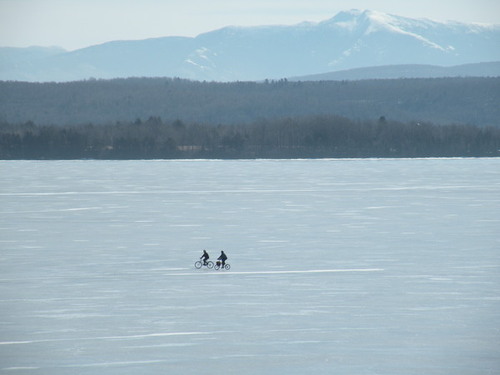
Biking across Lake Champlain


Photograph via twitpic.com

This arresting photograph of two bicyclists riding across the frozen surface of Lake Champlain captures the North Country spirit quite elegantly. And who says we put away our bikes when the snowflakes begin to fall. I have a friend who commutes an hour plus to work and then repeats the ride in the evening on a mountain bike with steel studded tires throughout the winter. In snowstorms. On icy roads. Up and down hills. Makes this photo seem like a leisurely meander…

Enhanced by Zemanta

Lake Champlain Sunrise

http://www.flickr.com/photos/virtualdavis/4447009355/in/set-72157623513486902
Good morning. Another sleepless night. And another spectacular morning. Just recompense. I’ve grabbed a brief video of the sun rising up out of the clouds above Vermont’s Green Mountains, above Lake Champlain that I’m adding to my Essex, New York flickr set. Nice that I couldn’t even remember what the date was…

Sorry that the quality is “poor”. I shot this on my Blackberry Storm2 through antique wavy glass. The result is a little bit dreamy.


Friday Flaneur: Munching Music


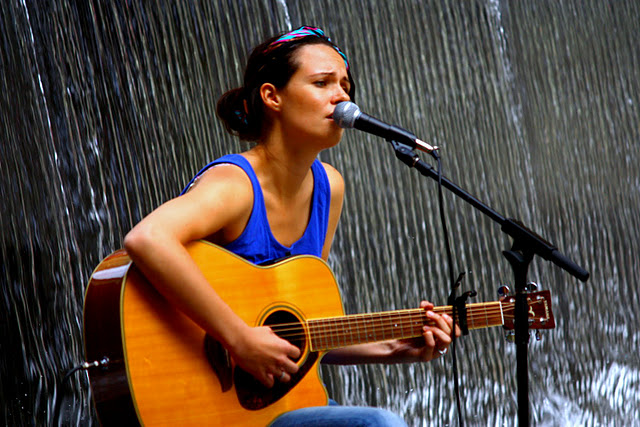
Photograph courtesy of Sydney Eye

An earnest folk-singer, in cavernous Martin Place, competes with a “burger with-the-lot”, for the attention of lunch time strollers. Better were she a plate juggling sword swallower, than guitar player.

Flaneur (n). A person who strolls the city in order to appreciate it.
Are YOU a flaneur – a la Baudelaire or Sontag?

View original post at Sydney Eye

Enhanced by Zemanta

Staring Flâneur

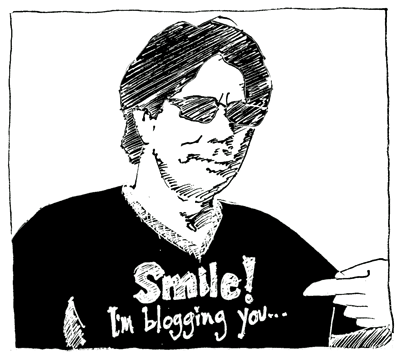
A little-known fact is that people wearing sunglasses never notice when you stare at them. Or, rather, you can’t see them noticing you, which amounts to the same thing: immunity to stare. [via Georgia Love.]

Apple Scrambles to Secure IPad Deals

Photograph courtesy of Getty Images via Wall Street Journal

Apple is still working to secure content for the iPad with just weeks to go before the tablet computer’s release, said people familiar with the matter, as the company tempers some of its initial ambitions for the much-hyped device.

Facebook Co-Founder Launches Non-Profit Platform Called Jumo

Today, Facebook co-founder and My.BarackObama.com alum Chris Hughes announced the soft launch of Jumo, his new philanthropic start-up that works to match do-gooders with appropriate causes.

Currently, the Jumo site is merely an elegantly designed homepage that announces Hughes’s mission to “bring together everyday individuals and organizations to speed the pace of global change. We connect people to the issues, organizations, and individuals relevant to them to foster lasting relationships and meaningful action.”

via mashable.com

Enhanced by Zemanta

Michael Sorkin Proves There’s a Raconteur in Every Flâneur

In Twenty Minutes in Manhattan, Michael Sorkin, an architect and critic, makes like Jacobs and immerses himself in the rhythms and patter of the street. He has shaped his book according to the contours of his daily stroll across a dozen or so blocks of Lower Manhattan, from the top floor of his five-story Greenwich Village walk-up to his office in TriBeCa. Walking, Sorkin writes, is “a natural armature for thinking sequentially,” providing opportunities for heady musings on all manner of city life. Yet his peripatetic narrative is anything but linear. Proving there’s a raconteur in every flâneur, Sorkin unspools strands of free-floating observations about a scattered array of urban issues and gathers them into a loose weave along his path downtown.

Read the article at The Nation

Enhanced by Zemanta

How Dan Barber Fell in Love with a Fish

https://www.youtube.com/watch?v=4EUAMe2ixCI

Chef Dan Barber’s inspirational presentation at TED Talks 2010 tackles a complicated dilemma facing chefs, foodies and fisherman today: is there a sustainable way to keep fish on the menu? His delivery and observations are enjoyable, and his conclusions are timely and wise:

“How can we create conditions that enable every community to feed itself? To do that, dont look at the agribusiness model for the future… Its high on capital, chemistry and machines. And its never produced anything really good to eat. Instead lets look to the ecological model, thats the one that relies on two billion years of on-the-job experience. Look to… farms that restore instead of deplete, farms that farm extensively instead of just intensively, farmers that are not just producers but experts in relationships because they are the ones that are experts in flavor too…” ~ Dan Barber

[This post was originally published as “How I fell in love with a fish” on the Emmet Carter green design blog.]

How I Fell in Love with a Fish


Chef Dan Barber’s inspirational presentation at TED Talks 2010 tackles a complicated dilemma facing chefs, foodies and fisherman today: is there a sustainable way to keep fish on the menu? His delivery and observations are enjoyable, and his conclusions are timely and wise:

“How can we create conditions that enable every community to feed itself? To do that, don’t look at the agribusiness model for the future… It’s high on capital, chemistry and machines. And it’s never produced anything really good to eat. Instead let’s look to the ecological model, that’s the one that relies on two billion years of on-the-job experience. Look to… farms that restore instead of deplete, farms that farm extensively instead of just intensively, farmers that are not just producers but experts in relationships because they are the ones that are experts in flavor too…”