If you’re tempted to dismiss the content of this digital story (DWI, designated drivers, etc.), think twice. You’ll be missing out on an innovative and pretty darn slick digital story. And the sobering tale of what happens after earning a DWI is also well worth the slightly over two minute digital pastiche. Check it out!
“It’s the stories, stupid. So, how you relate to people? How you connect to people? It’s not the data; it’s not the dry content. You’ve got to be throwing engaging content, stories, emotional connections that people can relate to… They want to hang out with experiences. They want to relate to humans. And we’re not just tags and data and facts, we’re people!” ~ Chris Camp
Chris Camp’s LavaCon take-away should be a familiar reminder to all at this point. Right? Wrong? Then watch the video again. Web 2.0 (as well as all effective media, marketing, teaching, etc.) needs to humanize and personalize their message. Real content for real people. Give your audience a reason to care. Tell them stories. Listen to their stories. Weave these stories together and you’ll begin to develop the sort of relationship you need if you want to conect in the digital age.
A table, a cup over this table, a woman looks the raindrops outside the window. Then, an old woman tirelessly tries to put the trash into the garbage collector. The Polish movie director Kieslowski was a genius in turning trivial instants into poetry. Finding art in triviality makes art closer to quotidian and makes life less difficult to be lived. The writer Brissac Peixoto discusses about this theme in his book “Paisagem Urbana”. Brissac defends the art arisen from the moment, the stare at something banal turning it into art — and only the instant in the middle of the contemporaneity’s paranoia can put the sceneries in relief. (obviousmag.org)
Transforming the quotidian into poetry and discovering art in the banal, this is the flaneur’s gift and responsibility. To create. To curate. To discern and share what is human, what it beautiful amidst the maelstrom. To frame and share what otherwise would have been lost, and in so doing to reawaken that humanity in all of us. A heady task for an idler, you say? Perhaps. But undertaken with resolve and satisfaction.
Did you ever get back from traveling and feel like you’re not quite at the top of your game? This is especially true with long distance jet travel. You step into a glistening time capsule in Istanbul, for example, and not too long after you step back out of the time capsule into the sunlight of Newark, New Jersey. You’re tired and addled. But there’s something more. Soul lag.
unlike other books or especially TV shows… that seem to move folks around the globe as if this was no big deal… Gibson actually discusses the problem of world travel, and encapsulates it in a single phrase: soul lag. It’s not that you’re tired, or that there’s some mysterious thing associated with jet travel known as “jet lag”… instead, he acknowledges that one feels, well, not quite all there when one gets to another place, as if your soul, unlike your body, cannot travel as fast as an airplane and therefore takes a little while to catch up with you… it’s like you’re existing about half an inch to the left of your actual body, and you can’t seem to reconnect with it… sometimes, in extreme circumstances, your soul never catches up. (second americano)
I’m especially keen on the visual image of my shadow self still trailing behind, trying to catch up, sort of like the visual traces in “old school” television.
Clever, clever, clever! A slightly annoying yet surprisingly compelling digital story about Mark Zuckerberg (the face behind Facebook), his web progeny’s appetite and the dietary choices Zuckerberg makes for said progeny. I’ll leave the conclusions up to you, but take a moment to experience this digital storytelling gem.
Update:
Activist efforts to green social networking giant Facebook appear to be gaining traction. Corporations around the world are watching and learning from Facebook, not just how to grow a business in record time, but how to respond to global pressure from the very social network you’ve created. Tolerance and dialogue are key, but so is weighing and responding to the needs of your constituents. The following stories are a good barometric reading. What will tomorrow bring?
Facebook Under Pressure to Be Greener “Facebook, the giant social networking site, is under fire from Greenpeace International, the environmental campaigner, over its construction of a data center in Prineville, Oregon, that will be powered by PacifiCorp, a company that gets 58 percent of its energy from burning coal…”
Facebook Saves Face, Joins Verizon, Sony, Microsoft in Green Coalition “Facebook is the latest digital giant to join the Digital Energy Solutions Campaign (DESC), a nonprofit launched in 2008 that brings together leaders in the information technology industry to work on environmental and energy consumption issues. The social network joins Intel, Verizon, Sony, Cisco, AMD, Microsoft, and Hewlett-Packard in the campaign, which works on sustainable best practices for large technology companies…”
Facebook Kicks Off A Weak Green Offensive “Facebook has been repeatedly called out for not doing enough to promote renewable energy for its new data center, so what is the massive social network doing with this public relations dilemma? Launching its own Facebook page and joining groups to demonstrate its green cred, of course…”
Facebook friends the environment … or does it?“Facebook announced today it’s going green. The social networking giant unveiled “Green on Facebook,” [and] … joined the Digital Energy Solutions Campaign, a group that works on public policy and setting standards for energy efficiency. In a way, the move marks Facebook’s position as a top, global company — it’s certainly trendy, if not mandatory, for all large, big-name companies to sign onto green initiatives…”
Facebook enlists in pro-green coalition “Facebook on Thursday unveiled “Green on Facebook,” a page dedicated to spreading environmental awareness and other “green” news, and in tandem announced its participation in the Digital Energy Solutions Campaign (DESC), a nonprofit coalition of large technology companies and trade groups designed to solving the problems of environmental degradation and energy consumption. It’s organized by the Information Technology Industry Council…”
It was difficult to think about metadata, RFDI chips and code breaking in the same context, or environment as storytelling. We had to rewire our thinking back to a simple place where story was central – but then apply the basics of that to an audience who consume story so very differently. Keep it simple, but then make it complex enough to engage on new, immersive and constantly evolving levels of engagement… I was lucky to debrief over coffee with Alison Norrington (PHD researcher, transmedia writer, storyteller) and we touched on the difficulties facing writers who want to work in this new environment… Lance Weiler called transmedia storytelling the return to a more ‘campfire scenario’ where stories become passed down, elaborated on, reinterpreted, and retold. So here we have flashes of Barthes ‘Death of the Author’ – since text and author are even less related under new storytelling methodology.
As a writer, or a storyteller, once again your creativity is at the heart, but ownership can’t be. (“It’s not you, it’s Media.”)
Wish I’d been able to participate in those three days in London!
In any event, the debrief is food for thought. For mind wandering. For wondering, and musing and mulling over and… Create. Share. Dig deep. Invent from the source. Share. Surrender your creation and move on.
What do you think about the future of storytelling in the digital age? Where do your storytelling dreams fit into the transmedia landscape?
“I found myself at work way too late trying to figure out some way to explain to a 12 year old why I worked for a youth-media organization and why it was important for people to create their own images, video and music (keep in mind that this was in 1998 before all this user-generated content stuff). Meanwhile, I was trying to remember if it was, in fact, important and what else might I be doing instead. Why was I doing this? I came up with something that sounded convincing to me. But, I’m a bit embarrassed to say that it was harder to answer than I expected.” ~Tony Deifell
Now Deifell is asking you to stop and consider the question too. And your answer. Will you take the time? Why do you do what you do?
I took a stab at it, a “rough draft”, if you will:
“I wonder/dream/adventure because I’m curious. I create stories to share the wonder/dream/adventure w/you! #wdydwyd cc @wdydwyd @Deifell” ~ @virtualDavis
But I’m going to revisit it. Or keep visiting it. Maybe there are many answers? Or different answers at different times? It feels good to chew on this question. Healthy. In fact, I’m heading off to Turkey with my bride and two friends. I’m thinking of asking them all to consider the question. Maybe I’ll convince one or two of them to let me share their thoughts when we get home. I’ll keep you posted…
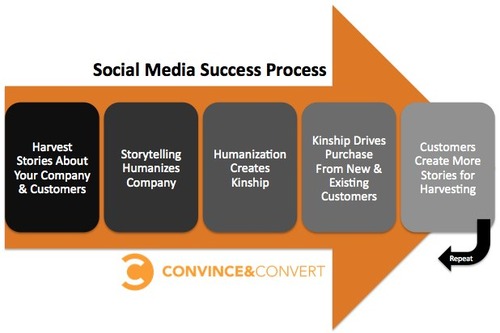
Let’s start with the grabbing. The graphic is titled, “Social Media Success Process” not “Process by which social media CAN drive increased market share.” There’s an implicit confidence, an assertion that collecting and sharing stories help a company. That humanizing a corporate entity through storytelling is beneficial. Amazing! Not everyone sees it that way. Some worry about the stories. Not the good ones. The other ones. Some worry about the loss of control. The potential damage to a brand. Of course, the near ubiquity of social media has changed so much for big corporations, not the least of which is that they can’t control and spin their message the way they once could. The consumer can access and share information readily, freely, easily, often. It’s easy enough to come up with the risk to companies today. Better play fair! But it’s even more intriguing to consider that stories of all sorts serve to humanize companies and therefore contribute kinship, community, value.
So, what irritated me? Perhaps this same confidence, er, hubris. Maybe it’s that third step: “Humanization Creates Kinship“. Sometimes it does. Sometimes it doesn’t. Sometimes it reinforces bias, distinctions, tribalism. Unless the stories are being curated carefully, thoughtfully, continually. But that’s not really the problem either, because I actually do believe that open storytelling will lead to open corporate culture which will lead to corporate consumables that have nothing to hide and nothing to spin. Some bumps and bruises might be incurred during the transition to this ideal model, but I’m confident it will happen. So maybe it makes sense to say that kinship will follow humanization, but it will be organic and gradual if storytelling and story sharing is truly open. Which leads me to the principle irritant: harvesting. In a model where we’re talking about humanizing a company, it is disingenuous to speak about harvesting stories. You harvest corn. Or apples. You don’t harvest people’s lives, people’s experiences, people’s memories, people’s emotions, people’s emotions, people’s stories. That would be dehumanizing. Make sense?
My fascination has already revealed itself. Stories and storytelling – at best – are not formulaic. Sure, we all learned the basic ingredients for a well crafted story as school children, but good stories invite us into an un-formulaic relationship with another person. Good storytelling is personal, authentic, intriguing, original. Good storytelling builds a unique bridge between story creator and audience. This is why we trust the storyteller, why we WANT to trust the storyteller. So it fascinates me to see this corporate storytelling model reduced to a tidy flow chart. A formula. Fascinates me largely because I think it is pretty accurate!
It lead me to writer and New York Times columnist Rob Walker, and the Significant Objects project. But first, let me connect a few dots. I got hooked up with Ripple100’s Andre Yap (@andreayap) a day or two ago in the magical jungles of Twitterlandia. Turns out we’re both story traffickers, albeit of slightly different stripes. This graphic was the top story on his blog, a good read if you’re a storytelling wonk, and after a little poking around while ruminating on the graphic, I learned about Rob Walker.
“Here is what Rob did. He purchased a bunch of random objects on Ebay. He then distributed the objects to his friends, asked them to write a short story about each. He then put the objects back up for sale on ebay, essentially sold $120 worth of objects for $3,612 – a 2,776% significance markup as he calls it. All based on stories.“(Ripple100)
Wow! That’s right. He turned $120 worth of knickknacks into $3,612 by adding a story to each auction item. Genius. Or is it? Maybe it’s just real world proof of what we already know. We love stories. Whether we realize it or not, part of our human nature is an appetite, possibly even a need for storytelling. And yet, it is difficult to put a value on stories. A book? Sure. A movie? Sure. A song? Sure. A short story published in a magazine. Sure. But in each of those cases, the value of the story gets muddled with the value of the storytelling vehicle.
“What is the actual value of a story? Are people prepared to pay more for something if there is a story attached to it? It turns out that they are. That is the outcome of a very original experiment by writer / NYT columnist Rob Walker… So people were prepared to pay a lot more than the initial value of the storyless object. In fact the difference was so big that Rob concluded that the real value was in the story – the object was merely the vehicle for the story.” (DoubleThink)
So it would seem that the value of each story was the difference between the original price of the object and the final price paid for the object and the story. You can review the experimental data, but it only tells part of the story. Remember that the storytellers intentionally or inadvertantly promoted the experiment, as did the organizers, bidders, etc. In other words, the experiment developed a story of its own. So not only were the objects vehicles for stories, but the entire project became a metastory. It bridged people, connecting them, creating meaning, memories, emotions. In short, the items, the storytellers and the project organizers were “humanized” by virtue of telling stories and weaving others into those stories. Or am I pushing the formula too far? You decide.
“What are people really buying? … There are no easy patterns to sort of say, like, well, this is exactly the answer… Every single object sold for more than we paid for it… The project itself became a story and what, in some ways, people were buying was a souvenier of this experiment.” (Rob Walker)
Kurt Vonnegut on short story writing (video via youtube.com)
“Here is a lesson in creative writing. First rule: Do not use semicolons. They are transvestite hermaphrodites representing absolutely nothing. All they do is show you’ve been to college.” ~ Kurt Vonnegut
Do you ever find yourself wishing you could shoot Ernest Hemingway a quick email to ask for a few tips? Or Jack London? Stephen King? Well, Kurt Vonnegut’s not such a bad fall back, so listen. Then re-listen. Then get to work!
“… there is something to be said for the joys of being a flaneur, even one in a taxi. As Walter Benjamin, that flaneur par excellence, said: it takes real skill to lose oneself in a city.” (Business Day)
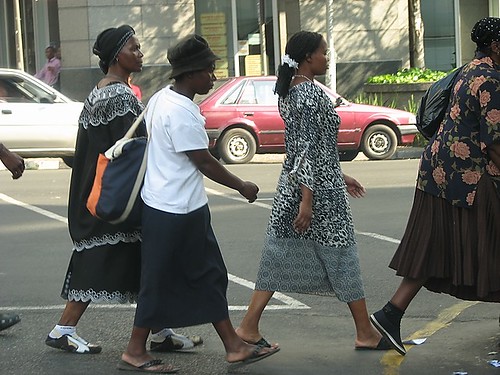
Jacob Dlamani, author of Native Nostalgia, reflects on the “joys of peregrination” in Johannesburg. In 2008, inspired by Ivan Vladislavic’s Portrait with Keys, Dlamani began exploring Joburgh on foot. Vladislavic didn’t shy from the omnipresent risk of wandering in this dangerous city: “It is also a melancholic take on what it means to live in anxious times and to walk through a city filled with nervous energy.” Dlamani also acknowledges the risk, recently having shifted from perambulations to vehicular meanders.
“My intention is to see Johannesburg from a different vantage point. This time, instead of seeing Johannesburg from the pavement up, I am trying to experience it from the relative “safety” of a minibus taxi seat.” (Business Day)
That image above is one of the “picture poems” I included in 40×41: Midlife Crisis Postponed and it combines contour drawings that I made in 1994 during my final year in college with abstractions from photographs that I took in Peru in 2011. I’ve previously posted elements of “Contours & Artifacts” in Choice (June 4, 2012) and Wonder (December […]







 , reflects on the
  , Dlamani began exploring Joburgh on foot. Vladislavic didn’t shy from the omnipresent risk of wandering in this dangerous city: “It is also a melancholic take on what it means to live in anxious times and to walk through a city filled with nervous energy.” Dlamani also acknowledges the risk, recently having shifted from perambulations to vehicular meanders.