I’ve been performing the Catch-Up Hustle this morning. Away from my desk for a week (eBook Summit 2010 and early Christmas with in-laws) but finding my groove again. Actually missed the rhythm!
“Nothing in the world can take the place of persistence. Talent will not; nothing is more common than unsuccessful men with talent. Genius will not; unrewarded genius is almost a proverb. Education will not; the world is full of educated derelicts. Persistence and determination alone are omnipotent. The slogan Press On! has solved and always will solve the problems of the human race.” ~Calvin Coolidge (via Fred Wilson)
Every day is Monday. Believe it. Live it. Love it!
Warren at The Doodle Daily shared a new batch of post-it doodles and this one was my favorite. Looks like an antique Portuguese tile. I instantly fantasized a Southwestern bathroom designed with these around a sunken tub, beneath a wall of glass overlooking the Sangre de Christo Mountains. And then I flashed back to amazing tiles we saw during our Splendors of Sacred India a year ago. And then even further back to Lisbon, Portugal in the autumn of 1999. How sad to see once magnificent buildings stripped of their famous tiles, stripped because they were more valuable for resale than as architecture and heritage.
I was living in Paris. I had spent August on vacation in the Adirondacks on Lake Champlain. A whirlwind romance. Then I returned to Paris and she returned to Manhattan. I think we were both a little surprised to miss each other. A summer fling. But the longing endured. I invited her to explore Cinque Terre with me over the Toussaint holiday. Within an hour she’d booked a flight. Within a couple of weeks we were falling head over heals in love with each other in Vernazza, Corniglia, Manarola, Riomaggiore and Monterosso al Mare. Four years later she became my bride.
Thanks for the memories, Ales Farcnik. And hat tip to to M. Faizan Sorathis (@Staticulator) who retweeted the “100 Beautiful Pics of Night” link that triggered this nostalgic flashback!
What does tomorrow’s publishing world look like? MediaBistro’s eBook Summit dove into the “New Era of Publishing” on December 15, 2010 at The New Yorker Hotel to explore “some of the most pressing industry issues” and to assist writers, editors, publishers and agent in navigating “the changing industry ecosystem.”
In January I start pitching Rosslyn Redux to a publishing industry that is not only new to me but new to itself. I figured this conference would serve as an informative industry barometer for me and an up-close-and-personal glimpse at how traditional publishers and agents are adapting to the Post-Gutenberg Paradigm. The day was an eye opener. Below I’ve overviewed the highlights.
Debbie Stier (@debbiestier) first came across my radar when HarperStudio was born… A book publishing outlet that made sense in the 21st century! Publishers who understood (or wanted to understand) the digital migration. Unfortunately bravery and vision weren’t sufficient, and HarperStudio was recycled. (Read the HarperCollins explanation memo to employees.) I was disappointed that the project was abbreviated, but proud of HarperCollins for taking the risk in the first place.
One of her homeruns with HarperStudio was Crush It! by Gary Vaynerchukwhich I’ve “read” three times (the print edition, the audio edition and the Vook edition) as much for Vaynerchuk’s energy, self-confidence and optimism as for the opportunity to compare assets distinct to each platform. I imagine Vaynerchuk has been a good fit for Publishing’s Optimist Prime. In an interview with Marian Schembari last June Stier conveyed unabashed enthusiasm for the future of publishing.
“I love that word-of-mouth is scalable. I love that anybody can share, and connect, and spread the word about great books and ideas without ever having to get permission… I’m allergic to bureaucracy. Publishing is full of protocols; I find it frustrating when people see their role as putting up barriers and looking for problems. I’d rather make something great happen… It’s liberating to know that you are in control of your own destiny and don’t have to hope that the gatekeepers allow you to be recognized.” (Digital Book World)
Stier’s perspective has encouraged and reassured me during my foray into the book publishing jungle. And it’s not all bluster and bravado. Stier’s track record speaks for itself. And she’s EVERYwhere! (I have a hunch that she may secretly have invented the social web between book launches.) The other day I was speaking to my wife’s cousin, Cali Williams Yost (@caliyost) about her experience publishing Work + Life and now working on her second book, and Stier’s name inevitably popped up: “She is wonderful and amazing!” Scanning some of the titles Stier has worked on I realized that my mother-in-law’s friend, Dotty Frank, has also been touched by Stier. The Stier Factor! And when I registered to attend MediaBistro‘s eBook Summit I discovered that she was slated to be one of the panelists. (Did I mention that Debbie Stier is EVERYwhere?)
During her eBook Summit presentation she announced that she’s departed HarperCollins, and that she hasn’t yet announced her next plan. She did mention that it is somewhat unrelated to book publishing but will draw upon her publishing experience. Hmmm… Perhaps something to do with the SATs?
As for promotion strategies in the publishing industry Stier articulated in no uncertain terms that
“everybody should have a digital presence… You’ve got to be part of it to understand, or else you’re not feeling the culture of it.”
She also skimmed over relevant tech/communication trends that she sees emerging. Mobile, mobile, mobile. There’s an adavantage to early adopters. If you use an iPhone, try out Instagram. In publishing, she explained, mobile strategy is mostly tied to apps (location-based and otherwise), etc. In other industries texting and QR codes are making major inroads, but publishing lags behind! This is an opportunity. First mover advantage. She touched on Foursquare and mused on behaviour changes like the gym rat badge. If you are writing nonfiction, Stier said, think of ways that FourSquare could overlap. Tips are key! And many other smart uses too. Leave breadcrumbs where you wrote the book, ate a meal, had a drink, etc.
Stier also emphasized the importance of “caring”. Adopt the Zappos strategy as DELL has recently learned. Care. Gary Vaynerchuck’s new book, The Thank You Economy, is precisely about this. In only a few short minutes Debbie Stier had nailed it. Boom, boom, boom.
Unfortunately she had to depart earlier than anticipated and we didn’t connect aside from a few tweets and this sad image but kind message on Tumbler. Soon, I hope, to meet the legendary Debbier Stier in person.
of the NRC Handelsblad Newspaper (Copyleft Avery Oslo)
In addition to the “write every day” and “create a routine” stuff by which so many other writers swear, Connolly stresses the need for flexibility. “There are many ways to get from start to finish,” he says. The key is to allow each project to be its own thing and deal with it in the way it ought to be dealt instead of tackling a uniform approach.(Kieron Connolly’s Newspaper Novel-Plotting Game)
This kernel of wisdom from Irish writer Kieron Connolly — the author of Water Sign, There is A House and Harold — was harvested during a novel writing workshop at the American Book Center in The Hague by Avery Oslo. It appealed to me for its candor and an almost unorthodox willingness to step away from the routine, routine, routine mantra which pervades much writerly advice.
Each new work is unique, and its creation may well require different routines, different methods and habits and rhythms than previous creations. This will to adapt the creative process per the needs of each new creation is not only more realistic than the systematic, procrustean assembly line model, it’s more exciting. Each new creative experience should be an adventure. A journey. An exploration. This is what makes creating and telling a story so damned interesting!
I wasn’t surprised that Avery Oslo (@AveryOslo on Twitter) had been inspired by Kieron Connolly, and yet I’ve never met either one. Chalk it up to Twitter. Again.
I don’t recall how I stumbled upon Oslo, but I suspect it may have been a retweet shared by a mutual acquaintance. A familiar “digital introduction”, followed by a visit to Avery Oslo’s blog where I read this:
I was raised by nomads (proper nomads. The kind that pick up and move every year at least once) and that makes me a native of nowhere (but also of everywhere!). I am most comfortable in mobile groups of other travelers and transplants. Everything I write addresses some aspect of being transient, at a crossroads, or otherwise in a state of flux. My characters often deal in the currencies of movement and future dreams. If you can relate to that, you might like what I write. (Avery Oslo)
I can relate to that!
Update:
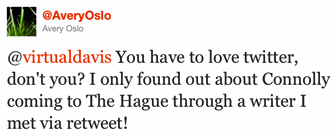
After posting this blog, I received the following tweet, adding another interesting Twitter twist:
According to Hugh McGuire the future of book publishing looks more like the internet than print books or even ebooks. Web-connected digital books are inevitable, and the line will vanishing between books and the Internet. Today’s savvy publishers will be tomorrow’s ebook API providers:
E-books to date have mostly been approached as digital versions of print books to be read on a variety of digital devices, with a few bells and whistles–like video… Thinking of e-books as just another way to consume a book lets the publishing business ignore the terror of a totally unknown business landscape… While you can list advantages and disadvantages of print books vs. e-books, these are all asides compared with the kind of advantages that we have come to expect of digital information properly hooked into the Internet…
Let books live properly within the Internet, along with websites, databases, blogs, Twitter, map systems, and applications… the foundation is there for the move. If you are looking at publishing with any kind of long-term business horizon, this is where you should be looking…
We are a long, long way from publishers thinking of themselves as API providers, or as the Application Programming Interface for the books they publish. But we’ve seen countless times that value grows when data is opened up (sometimes selectively) to the world. That’s really what the Internet is for and that is where book publishing is going, eventually…
The current world of e-books is a transition to a digitally connected book publishing ecosystem that won’t look anything like the book world we live in now. (Forbes.com)
I don’t need any convincing, but I found McGuire’s article straightforward and compelling. This isn’t rocket science, folks. It’s open source storytelling! And it’s one of the most exciting application of this global rhizome we call the World Wide Web. Like McGuire, I still can’t envision what the commercial underpinnings for this future of publishing looks like, I am confident that entrepreneurial minds all over the world are already scheming up efficient, reliable methods for monetizing web-enabled ebooks. Copyright issues will become increasingly complicated, but where there’s a will (and a market) there’s a way. And I’m thrilled to be able to participate!
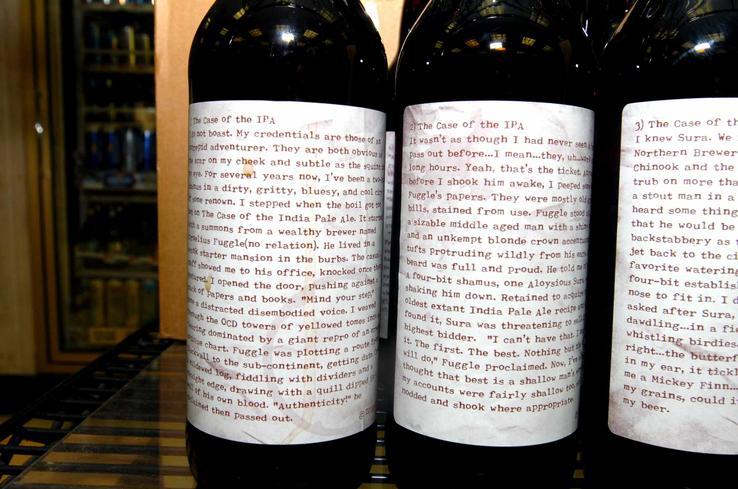
It’s no mystery that the folks at Just Beer at Buzzard’s Bay Brewing are a slightly quirky bunch, so it should be no surprise that their newest version of India Pale Ale is served up with a novel idea: A hard-boiled detective tale in twelve chapters, one on each of the 22-ounce bottles in a 12-bottle case.
The Case of the IPA, the name of the beer and the story, is a result of the melding of the minds of brewer Harry Smith, author Paul Goodchild and owner Bill Russell. The noir-style tale, reminiscent of “The Maltese Falcon” author Dashiell Hammett’s gritty detective novels and his serial magazine stories of the 1920s and ’30s starts off with the main character, “a two-bit shamus in a dirty, gritty, bluesy, and cool city of some renown” who is summoned to a wealthy businessman’s “swank starter mansion in the ‘burbs” and wraps up 264 ounces later. And Russell has one suggestion for readers: “Please don’t drink Chapter 12 first.”
Goodchild, who described himself as an artist who doesn’t count on royalties, said he came up with the idea of writing a story on Buzzard’s Bay beers about five years ago, but it didn’t fly until the Just Beer brand started making the 22-ouncer, just the right size for each chapter. “At first I thought about writing a science fiction serial because I love that genre, but I didn’t want people to think we were pandering to kids. This serial is decidedly adult — not XXX — but a hard-boiled detective, noiry serial; it’s perfectly oriented to the IPA. I’m a big fan of Dashiell Hammett,” said Goodchild. (Herald News)
Is it too late to pretend I invented this? This may be one of the most compelling reasons yet to focus on print publishing versus digital publishing. I mean, how often do folks offer up virtual cocktails on Twitter, etc? And how disapointing are they when you toss them down the hatch?!?! But this is the real deal. Analog literature for the mind and soul…
“In my world, copyright’s purpose is to encourage the widest participation in culture that we can manage – that is, it should be a system that encourages the most diverse set of creators, creating the most diverse set of works, to reach the most diverse audiences as is practical…” ~Cory Doctorow (via e-publishing, etc.)